
Continuous support in labour: how a doula improves birth outcomes
"You don’t need to know how birth works yet. You just need to know whether you want to go through it feeling supported, or feeling like you’re catching up the whole time." - Jilly Clarke, Doula, Antenatal Education Specialist and founder of CubCare
If you’re pregnant, there’s a good chance birth feels both far away and uncomfortably close. You might not know what contractions feel like, or what decisions you’ll face, or what your body will do — but you probably already know you don’t want to feel rushed, confused, or alone while it’s happening.
For many people, fear of birth isn’t loud. It doesn’t always show up as panic. It’s quieter than that. It’s the tight chest when you imagine being examined. The sudden heat in your face when you picture being asked to decide something quickly. The sense that once things start moving, you might struggle to keep up.
That feeling is often what leads people to ask about continuous support in labour — even before they fully understand what labour involves.
What does continuous support in labour from a doula actually look like?
Picture two labour rooms.
In the first, the door opens and closes. Different people come in. Questions are asked. Notes are written. They leave again, to check the next room. You’re left to ride the waves in between. Sometimes you’re coping. Sometimes you’re not. Your partner is trying to help but keeps looking at you, unsure what to do next. Time stretches. You listen for footsteps in the corridor. Contractions build while you watch the door, wondering when someone will come back.
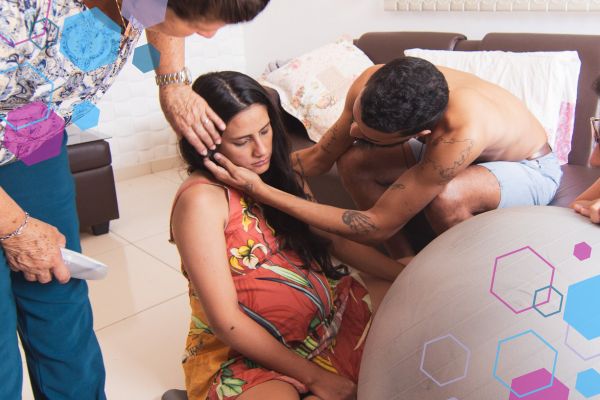
In another, you don’t notice the door at all — because someone is already beside you, tracking what your body is doing, helping you stay with it.
A contraction builds and there’s someone beside you who:
• notices your breath before you do
• helps you lean into your body instead of away from it
• suggests a shift in position without judgement
• talks quietly when the hallway sounds loud
• reminds you to drink as your mouth dries
• keeps your partner oriented and useful
• stays with you, not floating in and out
You don’t watch the door. You don’t spend energy guessing how to cope. Your partner isn’t trying to hold everything alone. Someone is tracking you — your body, your pace, your experience.
That’s what continuous support looks like in practice.

Why doula-led continuous support is linked to better birth outcomes
Labour is physical and emotional. How you feel in the room influences how your body responds.
Large reviews of research show that people who have consistent, one-to-one support throughout labour are more likely to have certain outcomes that matter to many — like spontaneous vaginal birth and shorter labours, and less likelihood of instrumental births or heavy reliance on pain medication. (This comes from pooled clinical trials analysed in the Cochrane review of continuous support during labour.)
The evidence doesn’t tell you exactly how you will give birth — it doesn’t speak to your courage or strength — but it does say that steady, continuous presence during labour is linked with these patterns.

How your nervous system responds when support is continuous
There’s a biological layer underneath every contraction.
When your nervous system feels held — when someone is there, tracking your rhythm with calm attention — it can respond differently:
• the alarm signals in your brain are quieter
• your focus shifts into your body not away from it
• your breath becomes a tool instead of background noise
You start to move with labour instead of bracing against it.
When support isn’t continuous you have more moments of re-orientation — “Who just came in? What just happened? Did I understand that?” — and each of those moments takes energy that your body could otherwise use for labour.
Birth partners and doulas: how support works together
Some people worry that having a doula means their partner loses space in the birth — but what usually happens is the opposite.
Your partner gets to be the person you lock eyes with — not the person scrambling to remember what you said you wanted at 2am, not the person trying to shoulder every emotion and every practical question on their own.
A doula often:
• helps your partner feel useful rather than helpless
• translates clinical language into something you can actually use
• offers reassurance so your partner can actually be present
Both of them can be there with you, without your partner having to manage the whole room.

Birth fear and what support feels like in real time
That background anxiety you come with — the one that shows up as a tight chest at the thought of a decision being sprung on you, or a flash of panic when someone enters the room unannounced — those sensations don’t disappear in labour.
But with continuous support, they become manageable:
• “This is a contraction and it’s normal.”
• “Here’s what’s happening right now.”
• “We can slow this down while we talk through your choice.”
You don’t suddenly stop feeling intensity — you’re just not processing it alone.
This is why so many people describe the moment support lands — it’s not when the baby arrives. It’s when someone looks at you with steady attention during something overwhelming, and for the first time in hours, you feel held by the moment instead of overwhelmed by it.
What changes when support stays with you as labour intensifies
As labour builds, most people reach a point where the work becomes less about coping with contractions and more about coping with everything else — the noise, the questions, the waiting, the effort of staying oriented while tired and uncomfortable.
This is often when people realise they don’t actually need to understand every detail of what’s happening in their body. What they need is to feel supported rather than constantly trying to catch up — to have someone alongside them who already understands the terrain and can help them stay grounded inside it.
When support is continuous, the room feels different at this stage. There’s less scrambling. Fewer moments of “What’s happening now?” More steadiness. Someone is there, noticing when things shift and responding without urgency or pressure.
That steadiness is what allows many people to stay connected to themselves through the middle stretch of labour, instead of feeling like events are pulling them forward faster than they can process.
What continuous support in labour means for your birth experience
You don’t have to decide everything today.
You don’t need a finished birth plan, a clear pain-relief strategy, or certainty about how labour will unfold. Most people don’t have those things — and they don’t need them.
What you can decide is whether you want to move through labour feeling supported and oriented, or whether you want to spend that energy trying to work out what’s happening as it happens.
Continuous support in labour means there is someone beside you who understands how birth actually feels — when it stretches on, when it intensifies, when it quietens and then suddenly shifts again. Someone who can help you stay connected to yourself when your thinking narrows and your body takes over.
For many parents giving birth in busy maternity units across Hertfordshire and North London, that steady presence is what helps them feel more grounded, more confident, and more able to stay with their birth — whatever shape it takes.
If you’re pregnant and wondering whether this kind of support would make a difference for you, the next step doesn’t have to be a decision. It can simply be a conversation.
Get in touch to talk about doula support for your birth.
Sometimes knowing someone will stay with you is enough to change how the whole experience feels.
→ Explore antenatal course for couples / the Birth Partner Course
